Endemic only to the island nation of Papua New Guinea , the Papuan black snapper (Lutjanus goldei) is a brutal adversary to anglers brave enough to target them. Strangely enough, these fish are not found in saltwater, but rather in the freshwater lakes and rivers of Papua New Guinea. Ian Middleton currently holds five line class records for this species and during a recent trip away from his hometown of Cairns, Australia, Middleton landed this massive 14.5 kg (32 lb ) fish that could possibly replace his current 3 kg (6 lb ) line class record. Fishing for barramundi on Lake Murray with guide Trevor Green on July 6, 2011, Middleton needed 42 minutes to land this toothy critter after it crushed the Sebile diving plug he was casting. Middleton’s current 3 kg (6 lb ) record is 9.07 kg (20 lb 0 oz ). www.IGFA.org
The web site for best sportfishing news and reports from all over the world.
August 29, 2011
August 28, 2011
August 27, 2011
Norway: salmon fishing news on Gaula river
Last Sunday started quite good, perfect water conditions and some fish were caught during the day. It was Thomas Aschpurwis who was able to land the first fish of the week in our Beat D1. He visited us the first time and it was his first go through our beat D1 with a black tube and he got a nice take. After a exciting fight he was able to land a nice salmon of 87 cm which weighed in with 5,9 kg (13 lb). Also NFC Daniel Stephan was able to land a nice fish in our beat C2. He estimated the weight of approx 6 kg (13 lb) and released this female salmon carefully.
www.nfc-online.com
Russia - Kola Peninsula: news from Varzina river
Some news from Varzina Trout Camp. Last week’s result is 270 trout for 10 rods. That was great time for trophy trout fishing. 53 trout were over 60cm in length. The biggest one landed by Esa from Finland was spotty trout 75cm in length, unfortunately we do not know the exact weight, as 5kg quick balance were not enough.
Salmon was caught rather seldom, but mostly because the majority of fishermen were focused on trophy trout fishing. All week it was very sunny. Fish was active since 8pm. Dring day time fishing was not very productive, so most of the fish were caught on bright streamers like Golden Killer or yellow-white variants. Among dry flies – caddis imitations work rather effective. During night time black streamers and nymphs were the best.
Previous fishing week came to its end by catching eighty first salmon. Every laded salmon during this week was over 20lb. Like last week at Drozdovka, at Varzina Lodge Janne Nyblom came to the top landing the majority of big salmon (95,98,99,100.102,103 and 107cm). The eighth trophy salmon was landed by Kibler Jochen (102cm). Surprisingly almost all landed nice salmon were female. Although all fish at river is already dark, fresh salmon of huge size still continue arriving to the river. Saying nothing of grilse with sea louse, at some closest to the lodge pools silver salmon of 5-6kg could be met. It’s, of course, autumn run fish. Although it’s too early for such a fish, it’s still very pleasant to land snow-white salmon. Lots of fish were caught on dry drifting flies like Bomber and Surfboard. Also, especially at night big black streamers work rather productive. Nights became darker, so it seems that theses weeks are the last when you can fish for salmon after dinner.
Salmon was caught rather seldom, but mostly because the majority of fishermen were focused on trophy trout fishing. All week it was very sunny. Fish was active since 8pm. Dring day time fishing was not very productive, so most of the fish were caught on bright streamers like Golden Killer or yellow-white variants. Among dry flies – caddis imitations work rather effective. During night time black streamers and nymphs were the best.
Previous fishing week came to its end by catching eighty first salmon. Every laded salmon during this week was over 20lb. Like last week at Drozdovka, at Varzina Lodge Janne Nyblom came to the top landing the majority of big salmon (95,98,99,100.102,103 and 107cm). The eighth trophy salmon was landed by Kibler Jochen (102cm). Surprisingly almost all landed nice salmon were female. Although all fish at river is already dark, fresh salmon of huge size still continue arriving to the river. Saying nothing of grilse with sea louse, at some closest to the lodge pools silver salmon of 5-6kg could be met. It’s, of course, autumn run fish. Although it’s too early for such a fish, it’s still very pleasant to land snow-white salmon. Lots of fish were caught on dry drifting flies like Bomber and Surfboard. Also, especially at night big black streamers work rather productive. Nights became darker, so it seems that theses weeks are the last when you can fish for salmon after dinner.August 20, 2011
Australia latest Fishing Reports
It seems like the good weather has paid off all round. While I reported yesterday that a few light tackle black marlin and sailfish have shown up in the north (as well as a 400lb black marlin on Opal Ridge), fishing elsewhere has been pretty good as well as boats take advantage of some better weather.
Rob Wood tells me that the sails have also arrived off the spit at Fraser Island. Rob tagged one while passing through the shallow water last week and reports that there is plenty of bait in the area with some good size fish spotted on the sounder. Black marlin have also turned up at 1770 within 3 km of the coast. Rob says the arrival of the small blacks in August usually coincides with a good years game fishing in the area so we're looking forward to hearing more!
Meanwhile, the big bluefin have turned up wide of Sydney with fish to 90kg weighed on Saturday while Ivan Bennett on Ambition got a 60kg fish on Sunday and weighed another 130.5kg!! Mark Curtis tells me the weather will probably shut it all down tomorrow but in the meantime, boats in numbers are getting great quality fish!
Kelly Dalling Fallon - Black Marlin Fishing Blog info@blackmarlinfishingblog.com
IGFA Hot Catches August 2011
Recent catches in Japan, Mexico, Canada, Panama, Australia, and California and Texas in the United States have anglers anxious to find out whether new World Records are about to be theirs! Check out the hottest All-Tackle, All-Tackle Length, line class, tippet, and Junior record applications to cross the IGFA World Records desk this month:
For the second time in the past few months, a Japanese angler has submitted an All-Tackle record claim for a large, unique species of grouper.
The most recent submission, from angler Takayuki Shibayama of Osaka , Japan , is for the appropriately named potato grouper (Epinephelus tukula). Fishing with guide Takashi Nakazato on June 4, 2011 off Miyako Island , Japan , Shibayama battled this bottom-dwelling monster for seven and a half hours after it inhaled the live snapper he was using for bait. After the strenuous battle, Shibayama’s potential All-Tackle record fish tipped the scales at 77.85 kg (171 lb 0 oz ). The current IGFA record is vacant.
Veteran angler Tom Pfleger of Newport Beach , California , USA recently submitted another line class record for white seabass (Atractoscion nobilis). Currently holding the men’s 01 kg (2 lb ) – 03 kg (6 lb ) line class records – Pfleger’s newest submission of a 25.85 kg (57 lb 0 oz ) catch aims to replace Jimmy Decker’s current 04 kg (8 lb ) line class record of 23.63 kg (52 lb 1 oz ). Pfleger landed his most recent seabass while fishing south of the border in Ensenada , Mexico on June 22, 2011. Forty five minutes after the potential record fish inhaled Pfleger’s live squid and sent his Shimano TLD screaming, the skilled angler had the fish subdued and in the boat.
This past June, angler Mark E. Carlson, M.D. of
Angler Francisco J. Rivera of
Smallfry angler Cody Konop, of
(mystinus) to qualify for the new male smallfry record. Cody needed just seven minutes to land the fish after it hit the Storm Wildeye Shad he was jigging.
Panama
Australian angler David Fent of
When most anglers are fortunate enough to land a big tripletail, the fish usually finds its way to the ice box and then the frying pan. Angler Stan Nabozny of The Woodlands, Texas, USA, had an All-Tackle Length record on his mind, however, after landing an enormous tripletail (Lobotes surinamensis) while fishing with Capt. Dwayne Newbern on July 8, 2011 in Matagorda Bay, Texas. After eating the shrimp that Nabozny cast to it, the fish fought for 10 minutes before being measured, photographed and released. Measuring 69 cm , this fish qualifies for the new potential All-Tackle Length record. The current IGFA record is vacant.
IGFA Great Marlin Race Combines Angling and Research to Learn more about Billfish
Marlin are some of the most magnificent fish in the ocean, but several species are sadly in serious decline. That’s why the International Game Fish Association has partnered with leading scientists from Stanford University to create the IGFA Great Marlin Race – a conservation research program which combines the excitement of tournament angling with cutting-edge marine bio-logging science. The part-competition, part-research Race has anglers and scientists alike excited for the launch at the 58th annual San Juan International Billfish Tournament on September 4 – 11, 2011.
Here’s how it works: in the days leading up to a billfish tournament, angling teams are invited to sponsor pop-up archival satellite tags (PATs) to be placed on fish caught and released during the event. One hundred and twenty days after each tag is deployed, it automatically releases itself from the fish – and its exact location is determined by earth-orbiting ARGOS satellites.
In a given tournament, the tag that surfaces furthest from where it was initially deployed wins the race for that tournament. The IGFA Great Marlin Race will last 12 months, encompass several tournaments, and deploy at least 50 PATs on a variety of billfish species in the Pacific, Atlantic and Indian Oceans. The marlin whose tag travels the furthest of all will be recognized at the IGFA annual International Auction and Banquet in January.
“The goal of the program,” further explains IGFA Conservation Director Jason Schratwieser, “is to learn more about the migration patterns of these magnificent fishes, and how they utilize the open ocean habitat. We also envision giving open access to the tagging data so that it can be utilized by scientists around the world.”
“The IGFA Great Marlin Race is one of the most ambitious conservation projects we have ever undertaken,” said IGFA President Rob Kramer, “and their high regard for conservation and sportsmanship at the San Juan International Billfish Tournament makes it a perfect place to launch the effort.”
Tags record information about depth, temperature and light levels – which can be used to study fish migrations and behaviors over the course of several months after they’ve been tagged. These data, in turn, will help scientists to identify key habitat areas where large numbers of fish spend significant portions of time – as well as the migratory corridors they use when they travel from place to place. Data from the PATs will be processed and disseminated via Dr. Barbara Block’s lab at Stanford University in California, USA.
Block pioneered the use of electronic tags on open ocean fishes in the early 1990’s. She was also one of the founders, along with IGFA Representative Bob Kurz, of the initial Great Marlin Race program – which was launched in 2009 in celebration of the 50th Anniversary of the Hawaiian International Billfish Tournament in Kona, Hawaii run by IGFA Trustee Peter Fithian.
“We are really excited about this new partnership between our organization and Stanford University,” explains Paxson Offield, chairman of the IGFA and long-term supporter of the Great Marlin Race. “By pairing top-notch science with tournament angling, we hope not only to learn more about the biology of the animals, but also to engage our constituents – billfish anglers around the world – in helping to conserve them for future generations.”
IREALND: a 54 lb tope shark caught
Stepeh Hayden was fishing with friends off Bray for mackerel and tope when he had a great run of luck. Everyone on the boat got tope and they were all good fish the highlight of the day was a double hook up. The luck anglers managed to get both fish to the boat and they weighed 42lb and 54lb.
August 09, 2011
RUSSIA: Ponoi river report (Ryabaga)
To summarize the first half of the 2011 season in Ryabaga I will turn back to May 28; upon arrival, our first group of Ryabaga anglers found the river level to resemble that of the mid-summer. A light snow-pack and an early spring thaw brought ice out and the spring flood well before our opening day, thereby allowing anglers to experience the unprecedented circumstance of wading and fishing dry flies on floating lines in the first week of the season. Moving into the second week, the majority of fish landed fell prey to the skated fly, an angling experience most salmon fishers certainly envy. Summer weather prevailed; short pants and sandals were a common site as anglers wet-waded their way through unseasonably warm days. The Home Pool produced an unprecedented 110 salmon for Week 2 anglers. During Week 3 a ten-year-old boy and his father encountered the unparalleled angling on Ponoi, thus spawning a passion for salmon fishing for a new generation of angler. Production of a not-yet-titled motion picture about Ryabaga underwent a series of shots from many angles, including some bird’s eye footage from the perspective of the Mi8 helicopter. A most amazing image was captured: rather than taking the fly, a salmon turned and batted the skated dry fly with her tail, a territorial response to something that could invade the redd and compromise thousands of eggs. Week 4 saw Bill Young and his timeless fly, the “Bill Young Fly” in “The Windows” at Kolmac. With a bit of determination and great skill, Bill produced a large cock fish of 23 pounds, alongside guide Barrett Mattison. Ilya Sherbovich, owner of Ponoi River Company, also visited Ryabaga in Week 4 to greet guests and observe the general plant, all the while managing to fish for a few days, in order to again whet his appetite for salmon; the long wait until autumn is an absolute impossibility for an angler as keen as Ilya. Our tagging program, with combined efforts of PINRO, the guide team, and the anglers, provided fascinating data of a fish that was tagged in 2006, and returned this year to spawn again. This occurrence, though uncommon, is a true testament to the strength and fortitude of Salmo salar. On the final week of June we were joined by two of the Frontier’s team, Joe Linscott and Joe Codd. The two made the trek to camp to catch salmon and to “suss out” the Ryabaga scene, as they will join in promoting and booking Ryabaga and Brevyeni camps into the future. During a one-day visit to Brevyeni camp and the surrounding waters, Joe Codd landed a 21 pound summer run salmon with guide Sergei Bistrov. During Week 6 our delegation of regulars from Finland pushed through tough conditions and turned up a fantastic week of salmon fishing not to be equaled anywhere else in the world. Anglers from Scandinavia often raise the bar with regard to effort and enthusiasm…at least this is the case with Erkki’s group. With the initial 7 weeks of the season complete on Ponoi, Max, Lena, and the majority of the guide team, kitchen team, and camp staff have flown back to town to recharge the batteries, soak up some sunshine, and have bit of a holiday. The mechanic team and guides Anatoly, Tommy, and Daniila remain in Ryabaga, which is now undergoing a bit of renovation and re-tooling. Projects currently underway include the completion of wood floors in each of the river lunch tents, new tables, and firewood cribs. Installation of three new guest tents will give anglers the opportunity to enjoy single-occupancy accommodations. Genia Flidner has been charged with the task of building a new dining table for the great room at the Guest House. Genia is a semi-professional carpenter, and his ability to work with wood is unmatched by anyone in Ryabaga or Kola Peninsula. With a fresh coat of paint, a bit of renovation, and some small additions, Ryabaga will certainly meet and exceed the expectations of guests this coming autumn. On August 7, we will welcome to Ryabaga Erkki Moisander and a split week of Finns. A total of 38 anglers will descend upon the banks of Ponoi, truly a sight to behold. One of the lucky Finns will likely land the first autumn run salmon, as the average catch date for the first autumn run falls in the first days of August. With so much to look forward to, our daydreams remain full of hard-fighting salmon and the glorious descent of autumn over Ponoi!
Matt Breuer www.ponoiriver.com
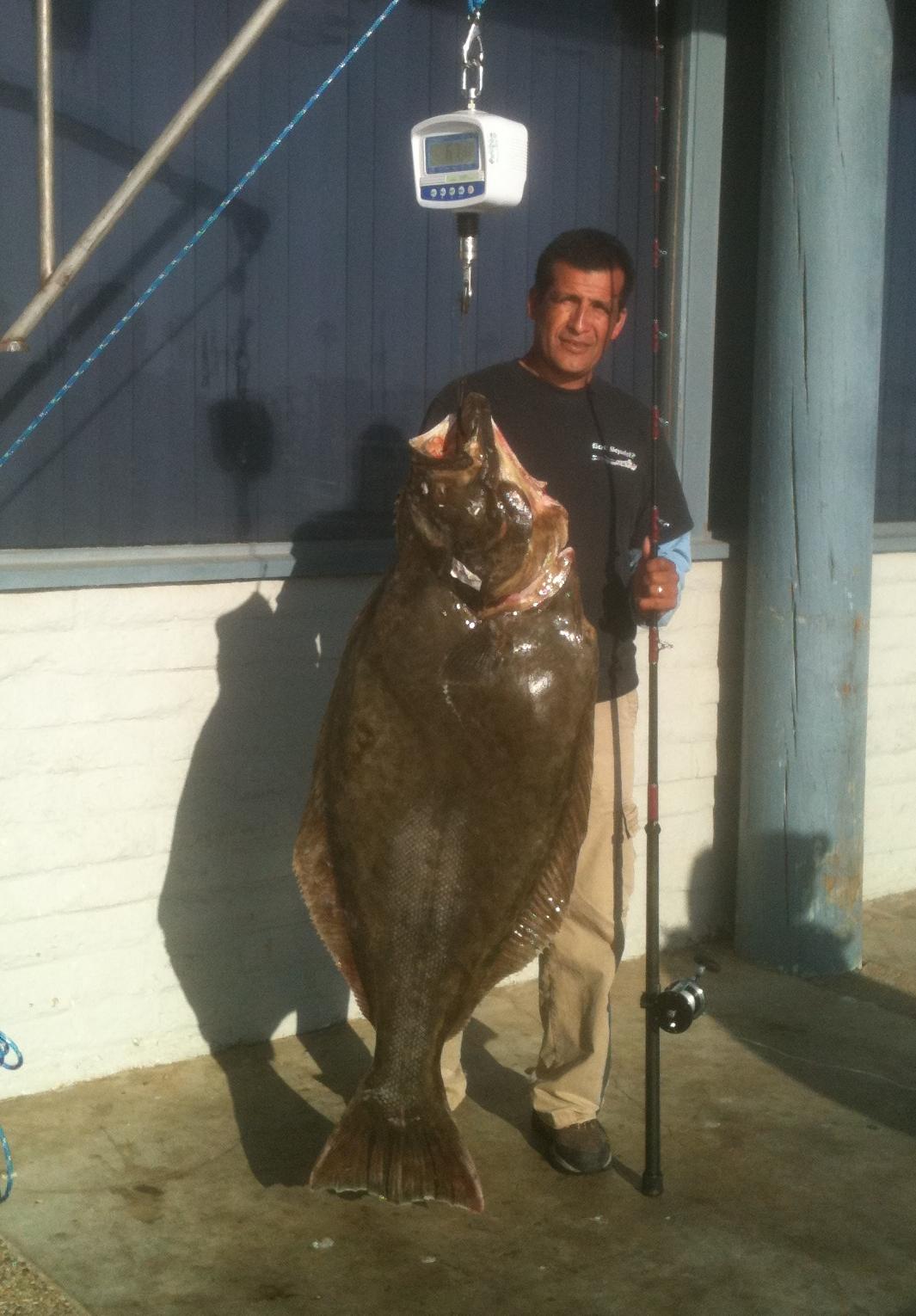
Norway: monster Atlantic halibut caught
A monster Atlantic halibut caught on norht of Norway in the Troms region.
In the period from 18.6. until 30.6.2011 skipper Ulrich Altstetter and his crew Wolfgang Boric, Reinhard Wührmann and Jürgen Grüneberg from South Germany after 2010 came for the second time with their own boat to the island of Senja in Northern Norway to catch halibut, cod and redfish.
On the penultimate day of fishing for the first time a presumably large halibut had taken one of the bait and line broke to our disappointment. Reason enough to the last day (Wednesday, 29/06/2011) again go to the same territory and end up with big rubber fish and 500 grams Bergmann jigs still to get a good fish for the photo book.
Reinhard Wührmann focused on the other hand, with its 3.20 m long "Denker" self made rod and a 200 gram jig to catch even one or two redfish or a cod for the last fish soup. A big fish in about 85 m depth seemed to care. He ignored it for the imaginary rubber fish and large jigs and grabbed the little colored 200 gr jig.
The Denker bowed reverently, the fish at the other end of the 0.23 mm braided cord seemed relatively unimpressed. The team watched the action in a few minutes, then was clear, that's a fish in the 3-digit and all other fishing tackle was taken from the water. While camera equipment and landing were prepared Reinhard Wührmann drilled the fish on the carrying capacity of its device without winning even one meter cord. On the other hand, the fish could not or would not dive into an approximately 140 m deep channel through which we drifted with about 0.4 kn.
We got a little worried because of a bad weather front in the south. Was still unclear how the whole thing would turn out, because now after 1 ½ hour intensive drill there was still not won 1 m line. Suddenly the pressure was to much and the Denker broke at the pin connection into two parts. Skipper Ulrich Altstetter due to its superior position in the boot took the rod, holding the cord under tension. Meanwhile, the broken rod tip slowly slid down on the braided line to the halibut.
But then the drill seemed to be effective and the flounder came up a few meters. First came to mind and then were also pronounced words like " we can get him .. " After another hour of drill time, the bad weather had moved back to happiness, dipped the tip of the rod on the water surface. The butt was right under the boat. With the rod butt, it was difficult to direct the fish to the side of the boat. Then, the halibut was seen the first time. A huge fish, which we estimated to more than 200 kg. Wolfgang Boric now led the butt to the boat and skipper Ulrich Altstetter harpooned the fish. The halibut was racing exploded in the depth and took line and harpoon line with it. To a holding was not thinking. The harpoon line was fixed to the side of the fishing boat "BLUEFIN". The line taut and the fish ripped the harpoon tip from his body. After 100 m the butt stopped his escape. It was the brake of the fishing reel Shimano Stella FA 10 felt hot, but was held to the enormous burden. After that the fish had to be pumped again to inch for inch to the top. Even after the second shot harpooning the fish it again, pulled it from the fishing line and could not be kept on a leash by two men. Stopped by the length of the harpoon rope the fish was pulled to the boat and then began to beat wildly at the surface around. Meanwhile Jürgen Grüneberg tried to photograph the scenes as best he could. After attaching a sling tail we were confident, this huge fish was caught.
Well, we dragged the halibut for 2 hours with 4 kn to the bridge of our fjord house. There 4 men moved the fish on the dock and we realized how heavy the halibut is really. We notified the neighboring Senja Havfiskesenter to weigh the fish. Unfortunately they didn`t have a suitable scale for the whole fish weigh and our balance was not good enough (max 150 kg weight).
It was presumptuous of witnesses, and weighed in pieces. The halibut was 2.55 m long, 1.36 m wide and almost 30 cm thick. The sum of the parts was 245 kg, is not considered lost blood and fluids. The head alone weighted 34 kg. At least now we knew: we have caught on light tackle under difficult conditions, a record halibut.
On the penultimate day of fishing for the first time a presumably large halibut had taken one of the bait and line broke to our disappointment. Reason enough to the last day (Wednesday, 29/06/2011) again go to the same territory and end up with big rubber fish and 500 grams Bergmann jigs still to get a good fish for the photo book.
Reinhard Wührmann focused on the other hand, with its 3.20 m long "Denker" self made rod and a 200 gram jig to catch even one or two redfish or a cod for the last fish soup. A big fish in about 85 m depth seemed to care. He ignored it for the imaginary rubber fish and large jigs and grabbed the little colored 200 gr jig.
The Denker bowed reverently, the fish at the other end of the 0.23 mm braided cord seemed relatively unimpressed. The team watched the action in a few minutes, then was clear, that's a fish in the 3-digit and all other fishing tackle was taken from the water. While camera equipment and landing were prepared Reinhard Wührmann drilled the fish on the carrying capacity of its device without winning even one meter cord. On the other hand, the fish could not or would not dive into an approximately 140 m deep channel through which we drifted with about 0.4 kn.
We got a little worried because of a bad weather front in the south. Was still unclear how the whole thing would turn out, because now after 1 ½ hour intensive drill there was still not won 1 m line. Suddenly the pressure was to much and the Denker broke at the pin connection into two parts. Skipper Ulrich Altstetter due to its superior position in the boot took the rod, holding the cord under tension. Meanwhile, the broken rod tip slowly slid down on the braided line to the halibut.
But then the drill seemed to be effective and the flounder came up a few meters. First came to mind and then were also pronounced words like " we can get him .. " After another hour of drill time, the bad weather had moved back to happiness, dipped the tip of the rod on the water surface. The butt was right under the boat. With the rod butt, it was difficult to direct the fish to the side of the boat. Then, the halibut was seen the first time. A huge fish, which we estimated to more than 200 kg. Wolfgang Boric now led the butt to the boat and skipper Ulrich Altstetter harpooned the fish. The halibut was racing exploded in the depth and took line and harpoon line with it. To a holding was not thinking. The harpoon line was fixed to the side of the fishing boat "BLUEFIN". The line taut and the fish ripped the harpoon tip from his body. After 100 m the butt stopped his escape. It was the brake of the fishing reel Shimano Stella FA 10 felt hot, but was held to the enormous burden. After that the fish had to be pumped again to inch for inch to the top. Even after the second shot harpooning the fish it again, pulled it from the fishing line and could not be kept on a leash by two men. Stopped by the length of the harpoon rope the fish was pulled to the boat and then began to beat wildly at the surface around. Meanwhile Jürgen Grüneberg tried to photograph the scenes as best he could. After attaching a sling tail we were confident, this huge fish was caught.
Well, we dragged the halibut for 2 hours with 4 kn to the bridge of our fjord house. There 4 men moved the fish on the dock and we realized how heavy the halibut is really. We notified the neighboring Senja Havfiskesenter to weigh the fish. Unfortunately they didn`t have a suitable scale for the whole fish weigh and our balance was not good enough (max 150 kg weight).
It was presumptuous of witnesses, and weighed in pieces. The halibut was 2.55 m long, 1.36 m wide and almost 30 cm thick. The sum of the parts was 245 kg, is not considered lost blood and fluids. The head alone weighted 34 kg. At least now we knew: we have caught on light tackle under difficult conditions, a record halibut.
It is currently regarded as the world's largest halibut caught by rod and reel.
Soure www.dintur.no
August 03, 2011
Kenya: SAILFISH GALORE in Malindi.
KINGFISHER NEWS UPDATE JULY 2011
It’s all systems go again in Malindi as far as the tourist season goes. It has been a long off season for Malindi’s inhabitants, most of who rely on tourism. From curio sellers to taxi drivers it has been a lean few months but it is good to see all the hotels open and lots of visitors walking the streets. On the whole the weather has been tourist friendly with mainly sunny days but luckily we have had over two inches of rain this month. After looking like the rain had disappeared at the end of June we have had the odd shower throughout July. Most of the month has been exceptionally windy with two or three fishing days having to be cancelled due to the wind and swell. Fortunately it started to calm down a week or so ago and it is a lot calmer and pleasant now.
Although we haven’t been too busy on the fishing side we have had enough days to keep things ticking over. Eclare was the first to get back into the water after off season maintenance and she has now been joined by Snowgoose. Both are glistening and looking ready for action. The plan is that Neptune will go in at the end of the month and Snark will come out for some TLC. After four months of non stop work by Angus and our maintenance team Neptune is looking very good. The new engines are securely in place and they are now doing final touches and needless to say Angus is itching to get going.
This off season has also seen a lot of purchasing on the tackle front and all boats will have a number of new rods, reels and rod buckets etc.
On the 12th July Eclare fished the first of eight days with Peter Voght from Germany who has been fishing with us for the past three or four years now. Although it was extremely rough the whole day they didn’t have time to think about it as they raised sailfish after sailfish to the baits. They raised over twenty fish and ended up with ten! Malindi\Watamu may be renowned for sailfish but ten in a day in July is some going.
Peter has now fished seven of his eight days and has caught a total of twenty nine sailfish with an average of four per day. Its not as if they have been spending the whole time targeting them either as most of the time has been spent live baiting for marlin or shark. The sail have been caught on the way there and back. Unfortunately there has been a lack of marlin on the banks up to now. They had a nice fish up one day which they missed a few times before a small hammerhead came and took the bait from under its nose! They released the hammerhead but the marlin disappeared. Tarka has had one marlin this season and missed a couple of others but on the whole marlin fishing has been slow. There is plenty of bait around so hopefully they will appear soon.
Both Eclare and Snowgoose were out yesterday. Snowgoose was on her maiden voyage of the season and ended up with five sailfish, a kingfish and a green job fish. Not bad for a half day! Eclare spent most of the day live baiting but still ended up with four sailfish.
That’s about it from here for this week. Once boats are going out more regularly the news updates will get more regular as well. We don’t seem to be too lucky when it comes to computers and e-mails and after having to change our domain a month or so ago, we lost a lot of stuff when our main computer crashed a couple of weeks ago. Unfortunately we lost our mailing list, so some of our regulars may not receive the update anymore. If you know anybody who doesn’t receive it and would like to, please ask them to send us their address. Similarly if you do not want to receive please let us know and send the address so that we can take you offwww.kenyasportfishing.net
Congo: exploratory trip for goliath tigerfish

Those who follow Tourette Fishing on Facebook may have been following our feeds and links with brief descriptions of our recent exploratory trip to the depths of the Congo rainforests. As far as exploratory trips go, this has to rate as one of the most epic trips we have ever experienced. We spent a week exploring a remote river in the heart of the equatorial jungle. The river is as far removed from civilisation as we have ever experienced, with absolutely no human interference what so ever for 100’s of kilometres. The aim of the trip was primarily to see if Goliath Tigerfish inhabit these far flung tributaries of the Congo river , and if they are a viable option for fly fisherman to target. Secondly, we were very interested in additional species that could possibly be targeted on fly. We CAN tell you that Goliath Tigerfish do indeed inhabit these small jungle rivers, which is great. Their numbers and the feasibility of consistently take them on fly is still debatable. We do feel that the area we visited definitely offers a very realistic option for those wanting to land goliath tigerfish on mixed tackle. Added to this, the amazing wildlife and birding make this the ultimate destination for the nature lover and fisherman looking to land a Goliath Tigerfish. It is however not for the fainthearted! We were also fortunate to target a new species of predatory Yellowfish which grows to well over 20lbs. The fish pictured here was specimen of average size, weighing in at 12lbs. As our understanding of this fishery improves and we are able to offer further details we will do so.
Subscribe to:
Comments (Atom)